
The right person, with the right authority — before you ever need it.
Power of Attorney in Tulsa, Oklahoma
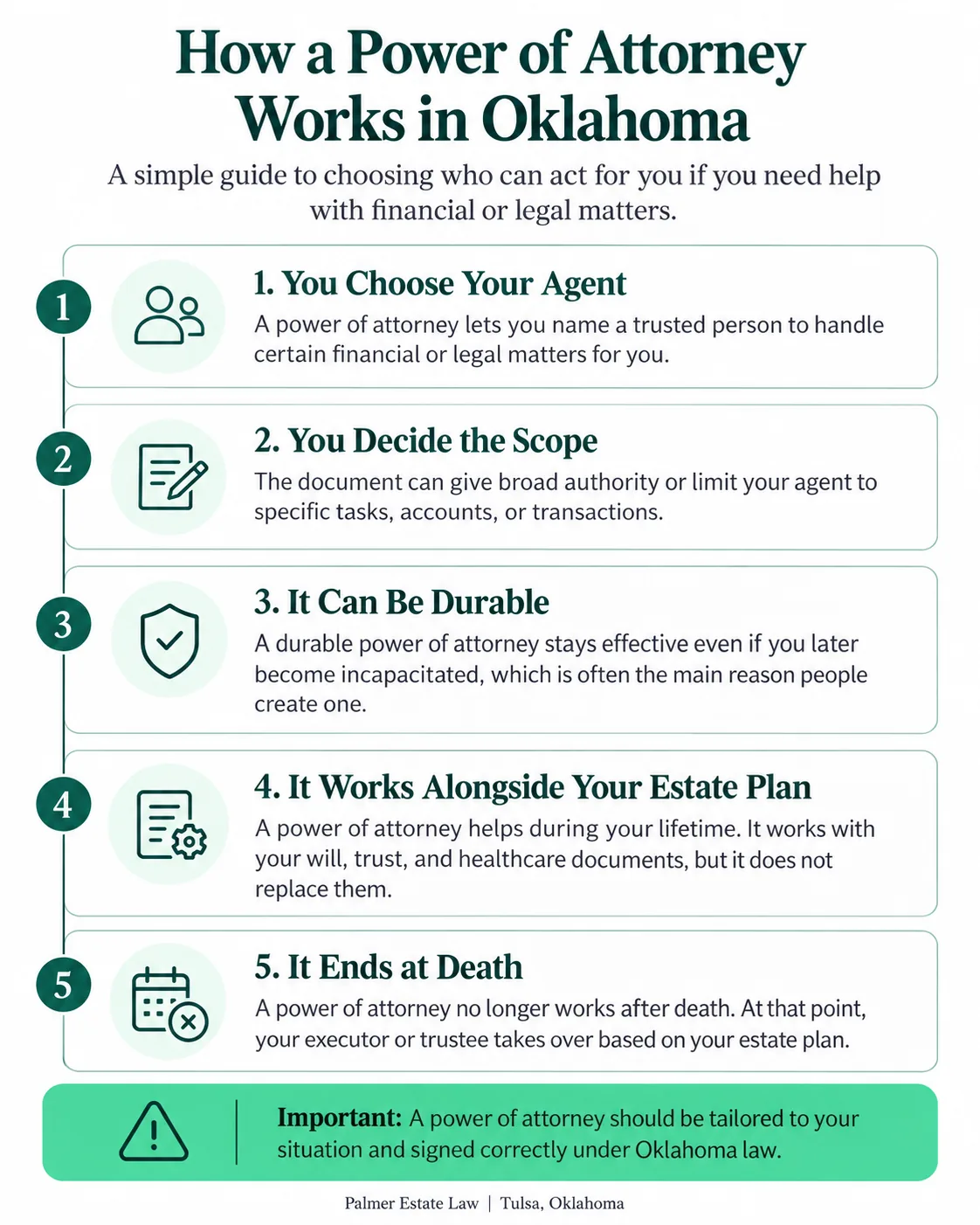
A power of attorney is one of the most important documents in any estate plan, and one of the most misunderstood. It lets you name someone you trust to manage your financial and legal affairs if you can't — and the key word is before. Authority has to be in place ahead of a crisis, because once someone can't sign for themselves, it's too late to create one.
At Palmer Estate Law, attorney Allie Palmer helps Tulsa families put the right power of attorney in place, choose the right agent, and understand exactly what that person can and can't do. This page covers financial and general powers of attorney; medical decision-making is handled through separate healthcare documents.
What a Financial Power of Attorney Actually Lets Someone Do
A financial power of attorney gives your chosen agent authority to step into your financial life and act for you. Depending on the powers you grant, that can include:
- Paying your bills and managing day-to-day finances
- Handling bank and investment accounts
- Buying, selling, or managing real estate
- Managing a business interest
- Filing taxes and dealing with tax matters
- Managing retirement accounts and other assets
The scope is up to you — a power of attorney can be broad or narrow. Some powers are significant enough that Oklahoma law expects them to be specifically granted rather than assumed, which is exactly the kind of detail we make sure your document gets right.
Durable Power of Attorney and Incapacity
This is the part that matters most, and the part people most often get wrong. A durable power of attorney stays in effect even if you become incapacitated — which is the whole point, since incapacity is when you most need someone able to act for you.
Here's the Oklahoma-specific detail worth knowing: under Oklahoma's Uniform Power of Attorney Act, a power of attorney signed on or after November 1, 2021 is durable by default — it survives your incapacity unless the document expressly says it ends there. A non-durable POA, by contrast, ends the moment you're incapacitated, which defeats the purpose for most estate-planning goals. We make sure your document says what you actually intend.
Oklahoma's Uniform Power of Attorney Act governs financial powers of attorney and defines when authority is durable and what an agent may be authorized to do.
Choosing the Right Agent
Naming an agent isn't a formality — it's the single most consequential choice in the document. Under Oklahoma law, your agent must act in good faith, within the authority you grant, and according to your known expectations or your best interest. That's real responsibility, and not everyone is suited to it.
When we help you choose, we look past the obvious. A few things worth thinking through:
Ability, not birth order.
People often default to naming the oldest child. But the right agent is whoever is the most organized, financially responsible, and trustworthy — which may be a different person entirely.
Willingness.
The role takes time and care. The right agent is someone actually willing to serve, not just honored to be asked.
Proximity and practicality.
An agent who lives nearby and can handle things in person can be easier than one across the country, though it isn't required.
Name a Backup — Why Successor Agents Matter
Here's a failure we help families avoid: you name one agent, and years later, when it's finally needed, that person has moved away, gotten sick, passed away, or simply declines to serve. If there's no backup named, your plan fails at the worst possible moment — and your family may be left seeking a court guardianship to get authority that a document could have provided.
Oklahoma law allows you to name successor agents — backups who step in if your first choice can't or won't serve. Naming at least one backup is one of the simplest ways to keep your plan from collapsing when it counts. We build that in as a matter of course.
Common Situations Where a Power of Attorney Matters
Abstract explanations only go so far. Here's where this document earns its keep:
The sudden hospitalization.
A Tulsa homeowner has bills due, an investment account, and a mortgage when a stroke leaves her unable to manage money for several weeks. A family member is ready to step in — but willingness isn't legal authority, and a bank won't let someone move money on her behalf just because they're related. With a durable financial POA already signed, her named agent handles the bills and accounts immediately. Without one, the family's only route is to petition the Oklahoma district court for a guardianship of the estate — a public court proceeding that requires formally proving incapacity, at the worst possible time.
The house that needs to be sold.
A parent moves into assisted living, and the family needs to sell the home to pay for care. A general power of attorney isn't automatically enough here: authority over real estate is one of the powers Oklahoma law treats as significant, and it needs to be clearly granted in the document. If the POA is silent or vague on real property, the title company may refuse to close — and the sale stalls exactly when the family needs the funds. Getting that authority right on the front end is the difference between a clean closing and a legal roadblock.
The trust isn't enough.
Someone sets up a revocable living trust but leaves their 401(k), IRA, and a couple of individually titled accounts outside it — as retirement accounts almost always are. If they're incapacitated, the successor trustee can only manage what's in the trust; they have no authority over those outside accounts. A financial power of attorney is what covers everything that lives outside the trust. This is why a trust and a POA aren't either/or — a complete plan needs both, working together.
The wrong agent.
A parent names their oldest child by default, though a different child is the one who actually handles money well and would act without conflict. Under Oklahoma law an agent owes real fiduciary duties — good faith, acting within authority, and in the principal's best interest — so the choice is about capability and trustworthiness, not birth order. The document is your one chance to make that call deliberately, and to name a backup if your first choice can't serve.
Do I Still Need a Power of Attorney If I Have a Trust?
Usually, yes — and this surprises people. A trust only governs the assets you've actually transferred into it. Your retirement accounts, and often a few other individually owned assets, typically stay outside the trust. Your successor trustee has authority over trust property; a financial power of attorney covers the rest. For most people, a complete plan includes both. (See our trusts and estate planning pages for how the pieces fit together.)
Financial vs. Healthcare — Two Different Documents
A financial power of attorney covers money and property. It does not cover medical decisions. Oklahoma handles health care authority through separate documents — a healthcare power of attorney and an advance directive (living will) — which name who speaks for you on medical matters and record your wishes for care. We make sure both sides are covered, with the right document doing the right job. Our estate planning plans include these healthcare documents alongside your financial POA.
Updating or Revoking a Power of Attorney
A power of attorney isn't permanent. As long as you're competent, you can revoke it or replace it — and you should revisit it when life changes. Good reasons to update: a divorce or falling-out with your named agent, your agent moving away or passing, a big change in your assets, or simply an old document that no longer reflects your wishes. An out-of-date POA naming the wrong person can be worse than none at all. If yours needs updating, we can prepare a current one that fits your situation.
Divorce is worth a special note: under Oklahoma law, if your agent is your spouse, their authority generally ends automatically once a divorce, annulment, or legal separation is filed — unless your document specifically says otherwise. That's a helpful backstop, but it's no substitute for formally updating your plan to reflect who you actually want in charge.
Also worth knowing: a power of attorney ends automatically when you die — at that point, your will or trust takes over. A POA is strictly a lifetime tool.
How Palmer Estate Law Helps
- We help you decide what authority to grant, and draft the document to match — broad or narrow, effective now or on incapacity.
- We help you choose the right agent and backups, thinking it through with you rather than treating it as a name to fill in.
- Because Allie's background is in accounting, the financial side — taxes, accounts, real property, business interests — is handled with real fluency.
- We coordinate your POA with the rest of your plan, so your trust, will, and powers of attorney work together.
A power of attorney is often most affordable as part of a complete plan rather than a stand-alone document — see our estate planning pricing for flat-fee options.
Why Families Choose Palmer Estate Law
You work directly with the attorney.
Allie Palmer personally handles your documents — no handoff to a form service.
Credentials that fit the work.
Allie earned her law degree with highest honors from the University of Tulsa College of Law and holds an accounting degree from the University of Oklahoma. She belongs to the Oklahoma Bar Association, the Tulsa County Bar Association, and the Tulsa Title and Probate Association.
Local and approachable.
We're in South Tulsa and work with families across Tulsa County and nearby communities, including Bixby, Jenks, Broken Arrow, and Owasso — in person or by Zoom.
Power of Attorney FAQ
A power of attorney lets you name someone (your agent) to handle financial and legal matters on your behalf. Depending on the authority you grant, your agent can pay bills, manage bank and investment accounts, handle real estate, deal with taxes, and more. It's a core part of planning for the possibility that you can't manage your own affairs at some point.
Yes. Under Oklahoma's Uniform Power of Attorney Act, a power of attorney signed on or after November 1, 2021 is durable by default — it stays effective even if you become incapacitated — unless the document expressly says it ends upon incapacity. Durability is usually what you want, since incapacity is exactly when an agent is most needed.
Someone trustworthy, organized, and actually willing to serve — not simply the oldest child or a default choice. Your agent must act in good faith and in your best interest under Oklahoma law, so ability and trustworthiness matter far more than birth order. We help you think this through rather than treating the name as a formality.
Yes, and you should. Oklahoma law allows successor agents who step in if your first choice can't or won't serve. Without a backup, if your sole agent moves, becomes ill, passes, or declines, your plan can fail — and your family may need a court guardianship. Naming at least one successor is simple protection against that.
It can — if the document grants that authority. Oklahoma law addresses an agent's power over real estate and other significant matters, and some powers need to be specifically granted rather than assumed. That's why how the document is drafted matters: we make sure it actually covers what you intend.
Yes. A power of attorney is a lifetime tool only — it ends automatically at your death, at which point your will or trust governs what happens next. This is one reason a power of attorney is part of a complete plan, not a substitute for a will or trust.
Your family generally can't simply step in. To gain authority to manage your finances, they'd typically have to ask an Oklahoma court to appoint a guardian of the estate — a public, time-consuming, and costly process, at an already difficult moment. A durable power of attorney avoids that by putting the authority in place ahead of time.
Put the Right Authority in Place
The best time to set up a power of attorney is before you need it. Contact Palmer Estate Law for a free consultation, and we'll help you choose the right agent and put the right document in place.
Palmer Estate Law · 9175 S Yale Ave #300, Tulsa, OK 74137 · Serving Tulsa, Bixby, Broken Arrow, Jenks & Owasso